Sam Goldsmith

A blog about music, travel, writing, photography, politics, Istanbul, teaching, life, and everything in between
Showing posts with label Düden Falls. Show all posts

Monday, October 31, 2011

"Waterfall Negatives"


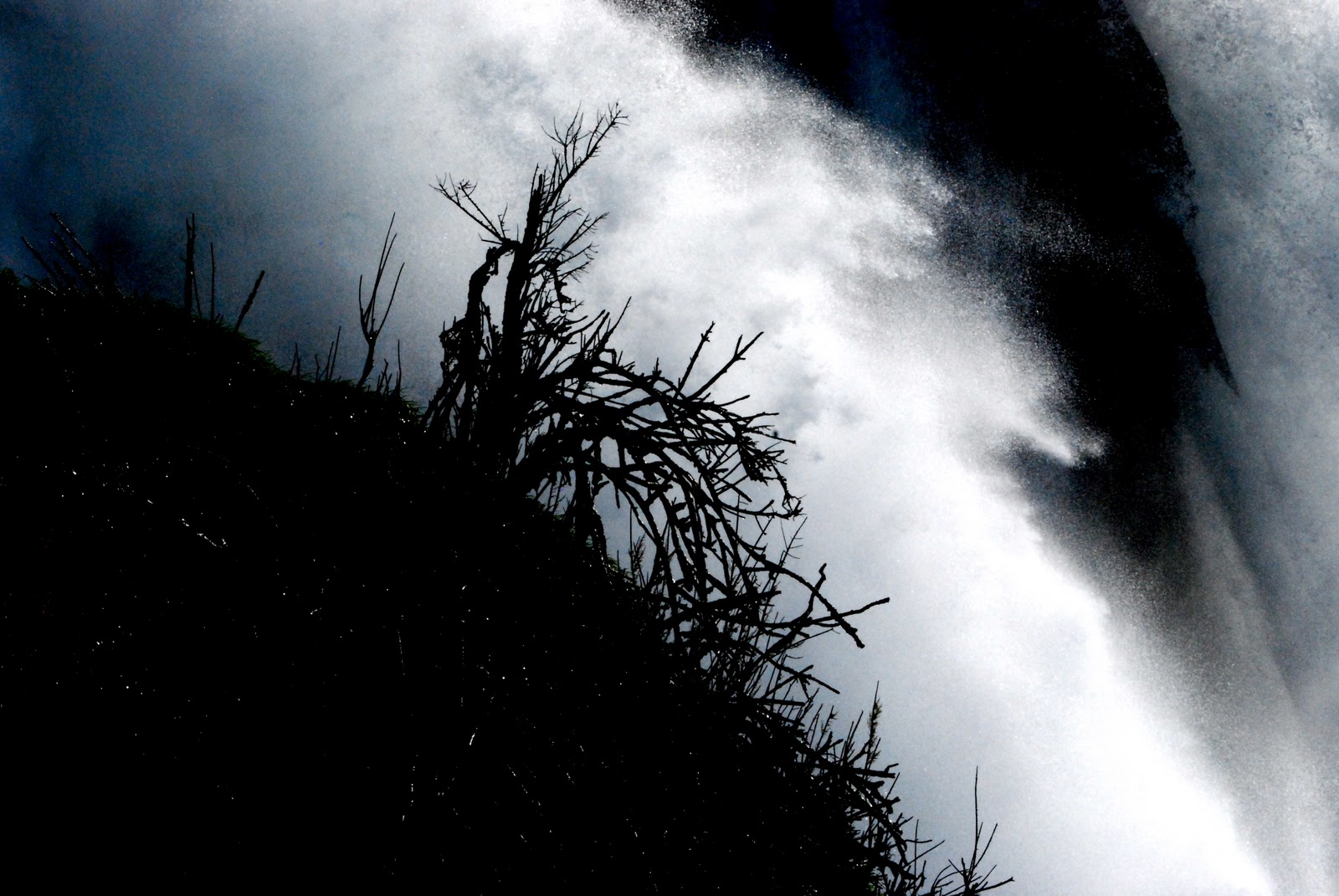
After my experience with Wahclella Falls the other day I've come to realize that one of my favorite things about waterfalls are the jets of water that shoot down, at the same time coming apart as the waterfall expands or dissolves into mist and coming together in jet streams. It helps to explain why I tend to like waterfalls much better than cascades (when the water falls along the side of a rock or a hill rather than through the air). In light of that I revisited some of my old photos and tried some color editing to isolate some of the waterfall jets like I did for my Wahclella Negative and Horsetail Negative. I think the style really emphasizes what's going on with the water, both how it's jetting (not a fast enough exposure to freeze the water in place except in the case of Courtney's Multnomah Falls photos) and breaking apart into specks of mist. The photos can sometimes look grainy but when I zoom in on them with my computer I can see that it's really a lot of individual water drops. I've also been looking at some of the paintings of Japanese artist Hiroshi Senju, who is famous for his waterfall paintings, like the one at the top of this post. Anyway, with no further ado, I hope you like some of the results of my photography experiments:

Lower Düden Falls

Lower Düden Falls
Lower Düden Falls


Upper Düden Falls

Latourell Falls (Photo by Courtney)

Latourell Falls (Photo by Courtney)

Lower tier of Multnomah Falls as seen above from Benson Bridge (Photo by Courtney)

Lower tier of Multnomah Falls as seen above from Benson Bridge (Photo by Courtney)

Wahkeena Falls

Now before I go, I need to address the current holiday. Yes, today is Halloween, and most of my readers know that I hate Halloween. But this year I have discovered something Halloween-themed that I can get behind! The waterfall that needs no introduction:


Yes, this waterfall is actually called Blood Falls, and it's real. It lives in Antartica, so sadly I'll probably never see it. Iron-oxide mixes with salt water to give it that eerie red hue. One website reports that it's 5 stories tall (compare it to the tent in the lower left-hand corner).

Happy Halloween

Saturday, May 21, 2011

Antalya and The Loving Düden Waterfall


I just got back after spending one crazy day in the beautiful Mediterranean city Antalya. I only wanted to stay for one day because I really only wanted to do one thing: to see the Lower Düden Falls (Düden Aşağı Şelalesi), the beautiful 40-meter (roughly 130-foot) waterfall that empties into the sea. I had planned to spend my entire day with the waterfall finding new ways to photograph it and to listen to it fall into the sea. For a variety of reasons that have to do with common sense, that wasn't possible. Still, after months of staring at online photos and YouTube videos of the waterfall during my prep periods in the teacher's room, I ached to see this waterfall.


My flight was supposed to get in at 7:50, giving me just enough time to see the waterfall by sunset. The flight was 3 and a half hours delayed because the engine had broken down (much better than the 5 hours the airline predicted, though), and I missed that chance. But when I got to my hotel room at 11:00 I still wanted to see the falls, even at night so I could hear it, so I went to check it out. I followed this pedestrian bike/walkway that I took a picture of during the next day (it turns out Antalyans are kind of fitness nuts):


Soon, however, I ended up in a construction site, abandoned in the nighttime. I passed mounds of dug-up soil and propane tanks and half-assembled concrete outdoor amphitheaters. I knew the way to the falls after studying the map so many times leading up to my visit, so it wasn't hard to figure out that the government was gentrifying the area around the waterfall. On my right was gravel construction tools, then the sea; on my right were half-finished cinderblock apartment buildings and condos. It didn't take long to feel like I wasn't supposed to be there, and being arrested for trespassing in a foreign country, let alone a city besides Istanbul, was an experience I'd be comfortable never having. But no one was around anywhere and I hadn't crossed caution tape or any barriers, so I kept along. And I really wanted to see this waterfall.


Of course when I got there I couldn't see it because it was far too dark - I could make out a few trails of dark gray along the black cliff side. I could hear it, though, and that was worth it in itself. But the bridge going over the top of the falls was blocked off by my-sized hills of dirt. I decided to brave it and climb onto the bridge as I'd seen a could motorcyclists do a moment before, and then I found myself caught in the headlights of a distant police car, which switched its red and blue lights on and I could even hear the siren over the rushing water below me. I guess I'm trying to write this poetically, but there's nothing poetic in how I instantly turned around and sped-walked away from the waterfall, frantically rehearsing what I'd tell the police if they caught up to me, reminding myself not to speak a word of Turkish, intentionally wearing my camera around my neck, and looking back every once in a while to see the car bounce over the dirt mounds blocking off the bridge. I think the car instead found a couple Turkish men I'd seen earlier, and I was off the hook. On the way back I saw the sign whose picture is above this paragraph.


As you can see, I got plenty of photos of the waterfall during the day (and as the picture above shows, people crossed the caution tape all the time), so my anxieties were unnecessary. But back in the hotel room I was devastated. I'd flown here to this city wanting nothing besides the waterfall, and that had been taken away from me. Why did they have to do construction while I was there? Why didn't anyone tell me? My English script of confused tourist prepared for the cops turned into a Turkish, intentionally broken and American-accented, plea to the construction workers to let me in for "sadece beş dakika, lütfen, beş dakika, Antalya görmek istemiyorum ama bu şelale çok görmek istiyorum" (bad grammar for: "I just want 5 minutes, please, 5 minutes, I don't ant to see Antalya but I really want to see that waterfall"). I even had a bribe price ready in my head, plus an argument against bribing if they demanded too much.


I took a shower and calmed down a bit, then came to the conclusion that the waterfall was telling me something. It wanted me to see the rest of Antalya. It didn't want the pressure of being the make-or-break experience of the 4 day holiday (Gençlik ve Spor Bayram, or Youth and Sports Holiday) that I'd been looking forward to for so long. It wanted to be beautiful, but not the be-all, end-all. So I made up my mind to walk along the Antalyan coast to the city center (ended up being about 11 kilometers, or 7 miles) the next day and try and swim in the sea (which is the one thing I failed at, but I don't mind). But first I'd convince those construction workers to let me see the waterfall in the early morning.


That cliff is just about the only place, besides a boat, where you can get a view of Düden Aşağı Şelalesi

Turns out I didn't need to convince anyone of anything. All the Antalyan health nuts were biking or jogging along the under-construction path around the waterfall anyway, so I just followed them and spent a couple hours with the waterfall. Even the bridge over the top of the falls was walked and cycled over. By the time I left the day's first tour groups were snapping photos all around the cliff area. It seemed silly that I had been so worked up the night before, but I somehow felt the waterfall could be more freely beautiful for me after I had dealt with the stress the day before.


Düden River suddenly jumps off the cliff and into the sea

Lower Düden Falls actually isn't a waterfall you can spend all day in front of, as I had originally planned on doing. For one, there's only one place you can get a clear photo. This also applies to the waterfall's sound. The cliff side is so verdant where the water drops that you hear two sounds: the normal mighty roar of a powerful waterfall, but also the calm spray of mist along the plants, a beautiful combination of bass and treble. Furthermore, the acoustics of its small gulf are so good that you can't really hear the waterfall at all until you reach the end of the opposite cliff and can actually see it. Even walking alongside the cliff and heading to the bridge, at one point you nearly lose the sound entirely, even when you can still see it. It's a gentle waterfall: just look at how calm the river looks just before it makes it's 130-foot drop (but I wouldn't recommend swimming!). However, the falls is powerful nonetheless, as evidenced by the ripples it sends deep into the Mediterranean Sea:


I also found a way down to the bottom of the falls, which was probably illegal but I was only following these fishermen:


Below is the cliff I followed them down. I saw a couple pieces of tiling that obviously used to be stairs, plus there were thick nails hammered into the rocks as well as footholds, so it seemed to anyone looking that a person was meant to climb down this way.


At the base of the waterfall I listened to its still beautiful voice as I watched the fishermen work and airplanes pass overhead; it turns out we had flown right over the waterfall the night before and I'd missed it!


There had been 4 fishermen, but only one photographed this well. Later he put on a poncho. I wonder if there were many fish to catch at the base of Düden.


When I came back in the afternoon I tried to go down there again, but that time there was a policeman and he called the stupid American tourist who had inhabited my body outside the restricted area. I told another man nearby in Turkish that I'd gone down earlier with the fisherman and no one had said anything. Later, when I went to the policeman to ask about buses to the airport, he said with a serious face (in English): "You went down there with the fishermen?" The man I'd made the offhand comment to seemed to be his friend. It was all okay, though, and we were all quickly joking around in Turkish about how great California is and how crazy people try to swim in the Düden waterfall and the city of Istanbul. People were very friendly to me through the day as long as I gave Turkish my best effort. I get the feeling that police officer wanted to take a swim in the waterfall himself.


Well, I did enjoy the rest of the city as well as the Lower Düden Waterfall, although admittedly it would have been impossible to top the waterfall (I've called it the "loving" waterfall in this post because it helped me deal with many more stresses than just the one I mentioned earlier, but it would be too long and complicated to get into those other ways here). I followed the walking-cycling path down Antalya's eastern coast and watched the mountains on the west grow more defined as the sun rose to its peak. It was a really beautiful walk, and occasionally I'd look down the cliffs to see miniature beaches and people celebrating the holiday in the water.


Eventually I came to this place, the Chocolate Hotel, and decided I should see what's inside. My family, especially my brother, has a thing about chocolatiers, and if this really was a hotel attached to a chocolate shop it would make a place with great character. Inside I met the owner, a Portuguese man who spoke perfect English and seemed glad to speak something besides Turkish, and he told me that the name fools tourists all the time because there's no hotel for people, just for chocolate.


We ended up talking for an hour as I tried the chocolates and drank tea. I could have easily stayed longer but the owner convinced me that I had to see the Upper Düden Waterfall that feeds the waterfall I'd flown out to see, so I had to cut our pleasant time short. It's rare to meet a fellow English-speaking (there are quite a few Russians) immigrant to Turkey, and the ones I meet here in Bahçeşehir sadly tend to be a little tired of the experience. It was refreshing to talk with someone who had so much energy and love for the Turkish culture and community, and even though there were difficulties (such as acquiring cocoa beans) it was well worth it to live here.


Apparently it's quite difficult to make original chocolate in Turkey because of strict import laws. I'm not sure I understand all of it, but making chocolate from cocoa beans is impossible unless you're a millionaire. The cocoa beans in the picture above were gifts, but buying a cocoa bean in Turkey in unheard of. The owner had originally wanted to make the shop's logo a cocoa bean, but he had to change it because Turks don't know what a cocoa bean looks like and it would just confuse them. The Chocolate Hotel has to (and this is what I don't quite understand) bring in ingredients from elsewhere and make the chocolates they sell on site. So they don't make their own chocolate because it's impossible, but they make their own chocolates. Either way, the chocolates I ate were delicious, especially the pistachio and the different truffles. We talked a little about cheeses, too: these tough import laws must also be why I don't see cheddar or gouda in any of the stores.


Me and Jorge, the owner of Chocolate Hotel

Go there if you get the chance. It was very interesting to see the chocolate-eating culture in a Turkish city, since I've only really seen one chocolate delicacy in Turkey throughout my travels, that being the delicious Beyoğlu chocolates you can find on Istiklal Street in Taksim. Jorge said he started the business because he had been looking for something that Antalya was missing (that's a big simplification of a much more interesting story), and the locals have been loving it.


Obligatory picture of the Fluted Minaret in Old Roman Antalya

I didn't go for the city's historic center, Kaleiçi, so much. It was overly touristy and very hard to find your way around. It was so touristy in fact that even speaking Turkish wasn't enough to stop street vendors and taxi drivers from trying to rip me off or lie about distances to things in order to get me in their shop or cab. I think this city is very popular for Turkish tourists, of which I saw many more than I saw foreign tourists. Maybe I'm ready for a break from historical tourism in favor of natural tourism - after Florence and Istanbul that might well be the case. Either way, I'd have rather been on one of Antalya's beautiful beaches than in the historical center.


Another of Hadrian's Arches. I've taken pictures of 3 of them, plus saw a 4th without taking its picture. And, yep, I still don't know who he was.


A woman taking a picture of Hadrian's Arch from above.


The Upper Düden Falls, maybe 10 kilometers from the city center, is in an out-of-place high end park (2.50 lira entrance fee) in the middle of a working class neighborhood. But the park, as planned out as it may or may not be (I haven't decided yet), shuts off the rest of the world brilliantly. As Jorge has promised, the mini forest around the falls makes everything green and produces misty rainbows around the waterfall. And the water is so green. And it stays that way 12 kilometers later at Lower Düden Falls as you can see from the bridge.


Upper Düden is a powerful waterfall. There's nothing graceful about it like there is about Lower Düden, and that might be why I like Lower Düden so much more. You could hear it in the roar of the waterfall and you could see it in the haste of the river above - Upper Düden can't wait to make the jump and crash ecstatically downwards. The sound wasn't nuanced or deep at all. It was just a loud roar. Not to say that detracts from its beauty, but it's simply impossible to see and hear that just after seeing and hearing the same river empty into the sea.


In the end, though, I don't think I can think of the two waterfalls as being separate. Obviously I have my preference about which half I like best, but I like to think that the two waterfalls are the same being having come to important realizations after its 12 kilometer journey to the sea. The first part is young, inexperienced, anxious, nervous, excited, and unsure. The lower half is patient, understanding, comforting, and loving with the wisdom it gained throughout its travels. If only I could grow as much as a person!


The eastern mountains, my back to Lower Düden Falls

After that I had to see Lower Düden one more time before catching my 10:30 flight. I watched it as the sun set behind me, and it gave me a little rainbow as if to tell me I had learned something.

Sunday, February 27, 2011

Selçuk, Efes, and Pamukkale


Me and the town of Selçuk

I’ve been having a very difficult time mustering the energy to write about the next couple stops on my holiday travel adventure because last week was a mother. In fact, I spent just about all of yesterday sleeping and doing nothing for the sake of recovery. While I’m tempted to do that again today and complete my second consecutive unproductive weekend, I instead am forcing myself to write.


Selçuk


Courtney at the ruins of St. Jean's church, looking over Selçuk

The town of Selçuk is small and quaint, and the number of people one could expect to speak English is far lower than Istanbul. This is the first city in Turkey I’d ever been to outside of Istanbul, actually, and I was interested in how different I’d find it. In general the biggest difference was that I was no longer in a gigantic city and instead in a country town with one or two main streets that last a few blocks each. Plus orange trees grew along all the streets. I picked one and tried to eat it but it was much to sour. Still, I liked that the trees bore fruit.

Orange trees in Selçuk. Courtney took this picture.

We stayed in the Var Dar Pansyon, a cute family-run place close to the city center, though it was too cold. The cute 8-year-old granddaughter spoke better than the elderly couple who seemed to run the place – we used our combined language skills to find out the internet password. It was also here we discovered something useful: lots of Turkish internet passwords are either 1122334455 or 0123456789, or some slight variation on this. Now you have the knowledge to hack into most Turkish wireless networks. This skill came in handy at least once during the trip. Later we met the mother, who was very helpful and spoke English very well. In the morning we took off our shoes and had breakfast (bread with honey, cucumber, cheese, and tea) in their living room with the other guests.


Entrance to St. Jean's Church

Selçuk is home of the Saint John (“St. Jean” on the signs) church ruins. Courtney knows more about the theology of the place than I do, but here goes: while it’s not where St. “Jean” was to have died but where he was last seen. Apparently there was a blaze of light and when it disappeared it had taken Jean with it. Or so I remember… angry comments correcting my inaccuracy are welcome. For me, the place was gigantic and fun to explore, especially since no one cares in Turkey if you touch or climb all over the ruins (Courtney really got into this aspect and ran her fingers over almost anything of interest, even in museums sometimes). It was a great place to play hide and seek, which is exactly what
Jean wanted, I’m sure. Outside people tried to sell us old coins wherever we went. I guess that’s the hip thing to buy in Selçuk.

Also very popular in Selçuk/Efes are genuine fake watches. Who woulda thunk.

There’s also a fortress on top of the hill in Selçuk, but it was closed and very hard to get a picture of. Plus I have no idea what its historical purpose was.

The best picture of the fortress I could manage

There was also a moderately famous and very old mosque, a double domed thing with a huge courtyard. The courtyard was more interesting than the mosque itself. I don’t know its name or why it was important, which shows how much of an impression it left on me.

The Mosque

The courtyard in the mosque

While there was a lot to love about Selçuk, and there was a lot we didn’t have time to see (the archeological museum, the different grottos, etc.), the best thing by far was a restaurant we ate at twice, called Firuze. Some great things about this restaurant: 1) Sometimes restaurants name their dishes “Imam’s favorite” if the Imam likes that dish the most. In Selçuk, the Imam’s favorite was a patlican dolma (stuffed eggplant), which we had tried in Istanbul and could not forget. For me, dolma is a cue word for “delicious.” 2) The Iskender Kabab (named for Alexander the Great) was the best of its kind I’ve ever had and one of those dishes you just don’t forget. 3) While the family who worked there had almost no knowledge of English and the clientele was entirely locals, they still treated us well and loved that I spoke Turkish with them. They recognized us the second night we came in. 4) It’s open until midnight every day and the prices were completely in our limited range. So if you’re ever in Selçuk, go there. In a different day we met some Americans and had a late dinner with them in the restaurant they swore by with some of their travel buddies and a guy I remembered seeing at Pamukkale. It was late and they were out of most things, so I shouldn’t judge too harshly, but Firuze was head and shoulders above it (though the guy who ran the other restaurant spoke English very well).


Efes


Courtney at the famous library of Efes

The main tourist attraction of Selçuk is that it’s in walking distance from Efes, a very well preserved ancient city that is one of Turkey’s historical treasures – if you see photo montages of Turkey travel attractions, the library at Efes is almost always featured prominently. The city of Efes used to be a very prosperous port city, which is baffling to think of now because it’s nowhere near the sea. There’s a harbor that now leads to wilderness. The city is so well preserved because it didn’t fall to conquerors but instead to nature; as the sea receded the city was no longer important as a port city and became abandoned. Now there are two very cool amphitheaters, a gate built for Hadrian’s visit, the long main street, the ancient harbor, and the gigantic and beautiful library. And we’re allowed to climb all over the place.

Hadrian's arch in Efes. You know, I've seen two arches built for Hadrian and I still have no idea who the guy was.


The ancient road to Water Castle, Efes.

On the walk to get to Efes, there’s an ancient temple to Artemis beside the road, almost completely lost to ruins besides the rough foundation and one impressive column with a bird’s nest on it. In Selçuk Courtney inadvertently picked up another guide dog who led us to the temple, where it left us for a Chinese tour group. Also on the walk to Efes we played around a little on an outdoor gym which offers no resistance. We have no idea how people think they’re getting exercise on those things.

Bird's nest pillar at the temple to Artemis. I'm pretty sure Courtney took this photo.

Courtney getting "exercise" on the way to Efes

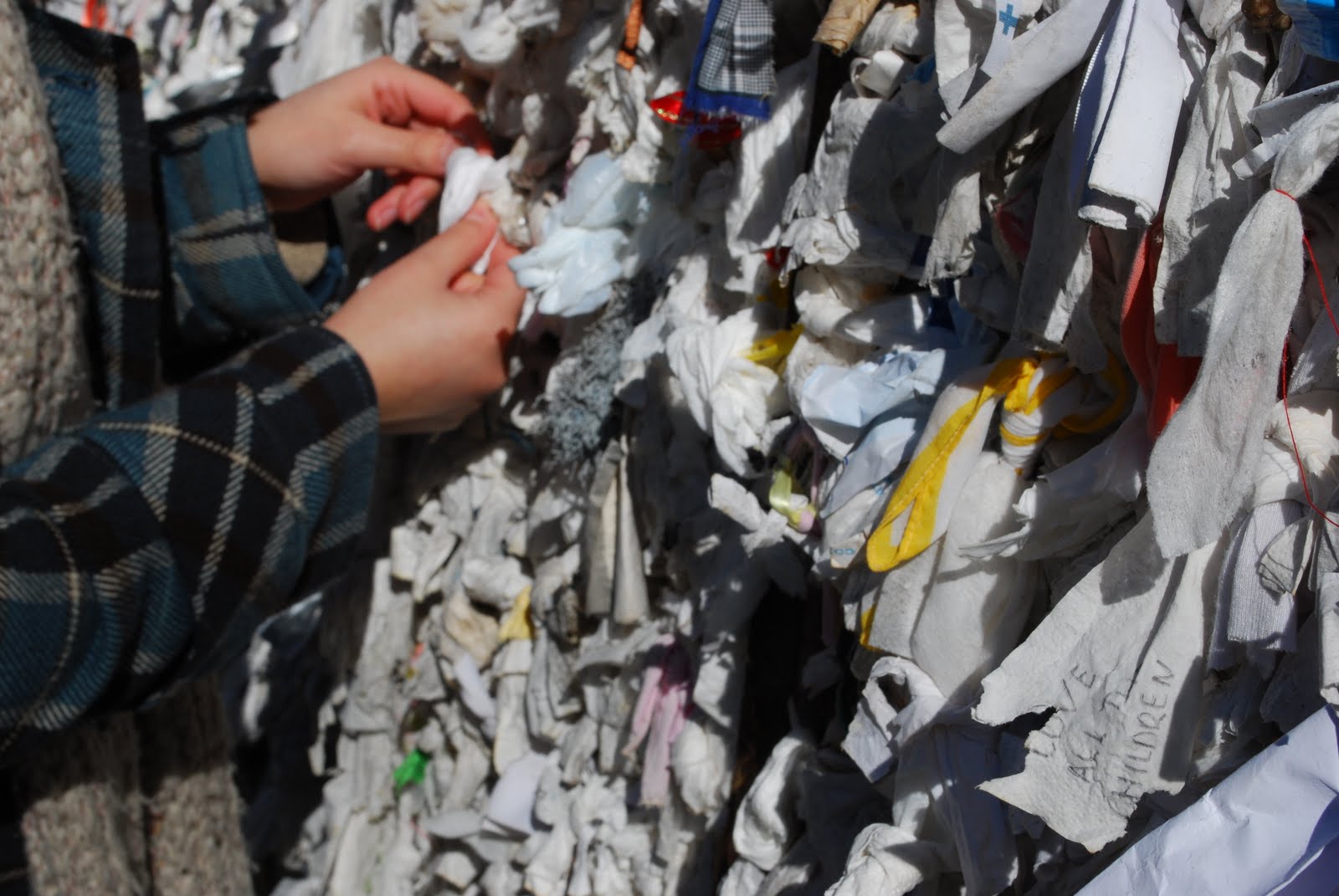
Finally, Selçuk is very close to the House of Mary, the place where the Virgin Mary was supposed to have lived the last days of her life. As the story goes, a bed-ridden nun in Germany who had never left the country recorded a series of visions about the house in precise details, which were later recognized to be the hills around Efes. Expeditions were sent out and the house was discovered. There’s also a stream that’s supposed to bring healing powers if you drink it. Courtney drank it (not for me, thanks) and put some on her aching back, and sure enough it didn’t give her problems for much of the trip’s remainder. There was also a place to tie prayers, which Courtney did and I watched her do.

Courtney tying her prayer to the prayer wall. The photo is focused on the prayer that says "Love all children."

The house itself was simple, bucolic even. Just a couple of small rooms with modest arches, a little carpeting, an occasional portrait, and an altar with a cloth and an embroidered Turkish prayer (which I could roughly translate for Courtney), seeing as the Turkish language existed by the time the house was discovered. It was amazing to see and compare to the examples I’ve seen in my extensive European tourism. Cathedrals, huge churches, dazzling artistry and craftsmanship. Christianity has always been this huge thing in my mind, and yet here I was as close to its source as I’ve ever been, and it was nothing but a tiny, humble shack. Is this the way it’s meant to be, modest and stripped of everything unessential, or was this just the meager start of something meant to be the huge movement I see today?

Mary's House, near Efes and Selçuk


Pamukkale


One of the best moments of the trip was a day trip to Pamukkale (“Cotton Castle”), a trip we seriously considered skipping because of the things we didn’t have time to see in Selçuk. I’m so glad we didn’t miss it! It was one of the most unique and gratifying things I’ve ever done.

One of Pamukkale's travertines

A stream of hot spring water going down Pamukkale. Courtney took this photo.

It’s impossible to get a notion of what it’s like to be at Pamukkale just by looking at photos or by reading these words. The place makes so little sense when you’re there, even when you’ve walked up and down barefoot and spent four hours thinking about it and watching it. I’ll try and make some sense of it for you, but that feels like an injustice to the place.

Courtney in one of the steaming travertines with mountains in the background

Scientifically speaking, Pamukkale is a natural hot spring, with waters roughly 36-38 degrees Celsius (something in the 90s Fahrenheit) with steaming waters rolling down a mineral deposit that turns the hill white. It gathers in little pools called travertines on its way down the slope.

Travertines from the top of Pamukkale. We weren't allowed in these.

I felt like the experience stimulated all five senses. We were not allowed to walk with shoes on, so we had to go barefoot on the mineral deposit. This was potentially a game-changer, something that would make me hate the day – the 3 hour long and very expensive bus ride was already bad enough. It was very cold outside, about 6 degrees Celsius, and I felt like my feet were going to fall off. As it turned out, though, walking barefoot was by far the best way to go. The white mineral deposit looks like snow from a distance, like Pamukkale is just a snow-covered hill, but when you walk on it it’s much harder than that. It digs into your feet like walking on a gravel driveway, and it turns out the little white ripples you see when you look close aren’t as sandy as they appear. It was so beautiful I had to stop and take pictures, but my feet wouldn’t let me stay put for long. The pools of water weren’t warm yet, not at the bottom of the hill, but we could see wet minerals, a freezing pasty, clay-like substance that seemed completely unrelated to the hard white hill we were walking on, even though it was the same thing just wet.

Pamukkale close up

Pamukkale's travertines as seen from the top. We weren't allowed in these, either.

Pamukkale close up with water trickling down

As we climbed the water gradually became warmer until we could comfortably walk inside a little stream the hot spring had cut into the minerals. We could see the steam rising up ahead of us and we could hear the water trickle down (yes, in trickle down economics the poor people only get the cold, feet-numbing Pamukkale where the rich get the hot spring at the top) and we could smell the heat in the air infused with minerals. Not to mention the gorgeous mountains surrounding the place on two sides, especially those across from Denizli (“with the sea,” which is stupid because the sea is like 2000 kilometers away from the city – but there are a lot of lakes…). We could smell the snowy mountain air with the heat and the minerals all together. It was bizarre. At this point I decided to include the one sense that had been left out and drank a handful of water – it’s supposed to be healing water anyway, according to the badly-written literature. It wasn’t delicious, just full of something. Turns out my sense of taste isn’t refined enough for me to describe it. Courtney wouldn’t try it, so I guess this makes up for the healing stream at Mary’s House, though I can’t say my body was healed after. My feet, on the other hand, definitely were. Courtney says she felt better after the hike up than the hike down, though I felt the reverse. One thing for sure, it was the best foot massage the world has to offer, and for days my feet felt better than ever before.

People trekking up Pamukkale

Courtney looking at the pasty minerals in one of the travertines with mountains in the background

Courtney taking a break with her feet in the warm spring. As a result of this some of Pamukkale got stuck to her jeans and came back with us to Selçuk.

As if this wasn’t awesome enough, at the top of the hill lays the ancient city of Hierapolis, which, little did I know, was on the same ticket as Pamukkale. The city used to be a spa haven, and there were bathhouses everywhere. I had neglected to bring a travel book, a terrible mistake, and in my mind I confused it with Pergamum and went in search of the agora, which turned out to be pretty lame in Hierapolis and is probably wonderful in Pergamum. On the other hand, I totally missed out on two things in Hierapolis I would have loves to have seen: 1) an apostle was supposedly martyred along with his family in one of the buildings, which would have been interesting to see, and more importantly, 2) there’s a swimming pool heated by Pamukkale’s source. The base of the pool is littered with ancient columns, marble structures, and whatnot. I could have swum with the ruins! I even had my swimsuit in case we were allowed to swim in Pamukkale’s travertines! I guess I just have to go back… We didn’t have enough time to go swimming anyway. That’s what I tell myself so help me go to sleep at night.

Ruins at Hierapolis with mountains in the background

Latrine. This picture's dedicated to you, Mom.

Still, Pamukkale was by far one of the best moments of my life and I totally recommend anyone traveling in Turkey not to miss it. I can’t describe it properly. You have to go for it to mean anything at all.

Can you see now why it’s so hard for me to go back to work? I’m already scheming about how I can make my way to Antalya and see the gorgeous Lower Düden Falls for myself instead of just ogling at pictures online: